
As your commercial real estate business grows, it becomes harder and harder to scale your management and accounting systems along with it. This is especially true if you still do everything by hand or rely on disconnected spreadsheets to track your expanding portfolio. In this article, we’ll review the problems that can arise from this kind of management and why you should switch to commercial property management software, plus a few tips on making the most of the transition.
Difficulties of Property Management without Specialized Software
Commercial real estate is a complex and constantly changing field. Trying to keep track of all the information you need without the proper tools leads to a long list of challenges. Below are a few of the most common difficulties.
Missed Dates and Deadlines
Even extremely organized lists and spreadsheets can’t send you reminders about key dates and deadlines such as rent escalations or lease endings. You’re forced to rely either on a separate tool or on your memory alone, both of which add unnecessary complication and room for error to your process. You risk missing these important dates, which can cost you revenue and force you to scramble to fill vacancies.
Lost Information
While manual data entry may work for very small businesses, the difficulty grows with the size of your portfolio. Entry mistakes or simply forgetting to update a spreadsheet can permanently lose or alter key information. As a result, your view of your portfolio’s performance is skewed, and you may even end up with inaccurate financial data, which is annoying at best and a liability at worst. It’s always best to use the tools that give you the best accuracy.
Poorly Defined Workflows
Managing all your processes by hand is a recipe for confusion. Rather than simple, shared workflows, your team may be forced to create intricate workarounds just to accomplish basic tasks like tracking rent or maintenance requests. These workarounds are difficult to teach to new employees and can lead to major delays if the team member regularly in charge of them is out of office or leaves the company.
Damaged Tenant Relationships
Poor workflows and difficulty finding the information you need when you need it can also result in poor customer service. Tenants may experience long wait times for maintenance requests or general concerns. Additionally, slow or inaccurate calculation of common area maintenance (CAM) fees or rent escalations can create frustration and mistrust. If tenants feel mistreated, they are likely to leave and may even discourage others from using your properties, which can significantly decrease your business opportunities.
Why isn’t Accounting Software Enough on its Own?
Accounting software is an incredibly important tool. Programs like QuickBooks allow businesses to keep track of key financial data in a single location. Plus, because most accountants and many business owners are already familiar with the software, it’s highly accessible, allowing your team to clearly view, understand, and work on data. Commercial real estate businesses benefit highly from using accounting software to keep the financial side of things in order.
However, commercial property management is a complex job that also involves tracking and handling many processes that aren’t included in most accounting software. This can include things like maintenance needs, which require an entirely separate tracking system, but also financial transactions like rent payments, which are specific to real estate. Generalized accounting platforms usually do not have tools built in to handle these specialized tasks. Property management software fills in these gaps.
What Switching to Commercial Property Management Software Offers
Commercial property management software is designed for specialized real estate needs. While each platform is different, this list explains a few common and particularly helpful features.
Automations
Automation is a key aspect of running an efficient, scalable commercial real estate business. Rather than relying on long, complicated, and error-prone processes performed entirely by hand, property management software performs complex tasks like CAM reconciliation for you with a single click. Not only do you receive faster, more accurate results, but you can spend more time focusing on your business goals rather than double- and triple-checking your math.
Clean, Readable Reports
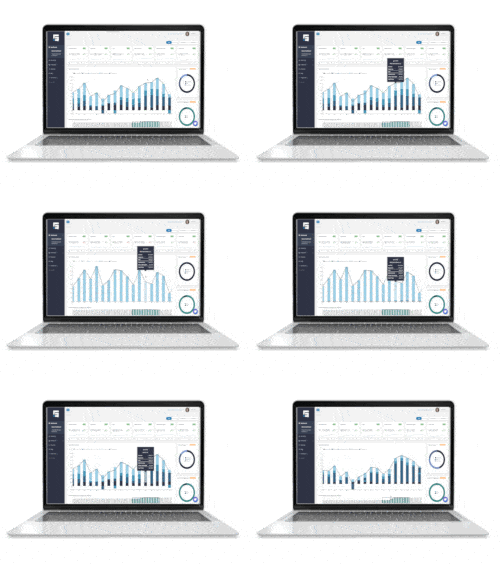
Similarly, handmade reports can end up messy, confusing, or misleading. With property management software like STRATAFOLIO, you can quickly generate reports displaying exactly the data you need. You can choose to zero in on a specific property or get the full picture of your complete portfolio to better understand your business’s performance and easily spot issues. You can pull reports on rent per square foot, or operating expenses per square foot, and so much more. You can even create reports tailored for investors, efficiently explaining what they need to know and helping build your reputation as a thorough and upfront property owner.
Tenant Portals
A dedicated tenant portal is one of the most important aspects of strong commercial property management software. Tenants can use online ACH payments to make rent simple, and can also use the portal to submit maintenance requests and contact you with questions or concerns. In turn, property managers can monitor rent payments, get in touch easily, and ensure that maintenance needs are resolved in a timely manner. As a result, you get satisfied tenants and simpler workflows.
Lease and Document Tracking
Store all your leases in a single convenient location with property management software. Commercial leases are often complex, and even neighboring tenants in the same building are likely to negotiate individual terms and exceptions to fit their individual needs. This can make processes like CAM reconciliation and lease escalation complex, as you must be able to quickly and accurately reference the specific lease terms of each tenant for fair and accurate results.
Additionally, having leases on hand helps prevent or quickly resolve any disputes that may arise, as all parties can confirm their rights and responsibilities. You can even store additional documents like tenant certificates of insurance (COIs) for further clarity and protection.
Alerts and Notifications
Easily set up alerts to automatically notify you of important but difficult-to-remember dates. You’ll never miss a rent escalation or a lease ending again with this handy feature. Instead, you can plan ahead to seek new tenants and ensure you’re charging the right amount, turning potential challenges into opportunities for growth.
Tips for a Smooth Switch to Commercial Property Management Software
Even though using commercial property management software will save you time, money, and stress in the long run, making the switch does come with a few challenges of its own. The good news is that with the proper preparation, you can set yourself up for an easy and beneficial transition. Here are a few of the most important things to keep in mind when it’s time for you to upgrade.
Choose a Software that Matches Your Needs
Picking the right software is the best thing you can do to make sure everything runs smoothly. Paying for a software that does too little or doesn’t offer the right tools is simply a waste of money, leaving you scrambling for solutions just like before. On the other hand, paying for enterprise-level software as a smaller business can be equally problematic, as these tools have a much steeper learning curve and will likely offer far more than you actually need.
Make a list of your most important needs from a property management software and do your research to find a program that matches. Reading reviews and taking advantage of free demos are excellent ways to make sure you know exactly what you’re buying.
Organize Your Data for A Clean Transfer
Make a list of all the data you’ll need to bring into your new software. Remember that this includes not just financial data but also details like leases, tenant contact information, and maintenance processes.
Ensure that this data is as organized as possible for a simpler transfer. This will also help you spot any errors or missing information after the process.
Communicate the Change with Employees and Tenants
Be sure to inform both your team and your tenants that you will be adopting a new software well in advance. Clearly state what the changes will look like for them: for example, tenants may now be able to pay online with ACH, while employees will be able to switch to new, more efficient workflows. Highlight why the change benefits everyone involved, and be available for any questions or concerns that might arise.
Take the Time to Learn the Software Well
The best way to minimize confusion when implementing new software is to take the time to really learn how to use each of the tools you’ll need. Test processes with your team before implementing them with real data and real tenants so you’re prepared for any challenges that might arise. You may want to prioritize software that offers a complete onboarding service and an attentive help team.
Additionally, try rolling out new features slowly to avoid overwhelming your team.
Transition Smoothly to Commercial Property Management Software with STRATAFOLIO
If you’re ready to make the switch but still aren’t sure where to start, STRATAFOLIO is here to help. Designed specifically for commercial real estate businesses, STRATAFOLIO offers cutting-edge automation and report generation alongside key features such as alerts, tenant and investor portals, and document storage.
To learn more about how STRATAFOLIO can help your business take the next step, schedule a free demo today.