As a commercial property owner or manager, have you ever been asked for a rent roll? If you’re new to the industry and haven’t yet encountered this key document, you certainly will soon.
Investing in commercial real estate isn’t just about the value of the property itself. It’s also essential to determine the value of the income stream, both present and future. While rent roll isn’t quite as easy to generate as the price-per-square-foot of a property, it helps you determine the actual value of an income-generating property. It’s an essential part of running a commercial real estate business. Here’s what you need to know about rent roll.
Executive Summary
- A current rent roll gives owners, lenders and investors a quick view of occupancy, lease terms and expected income.
- Incomplete or outdated rent-roll data can create due-diligence delays and undermine confidence in portfolio reporting.
- Consistent updates and centralized lease data make rent rolls easier to produce accurately.
What Is Rent Roll?
Rent (or rental) roll shows vital financial information about a rental property. Rather than going into all the details, it offers an overview of the property’s financials. It often fits on one page or less. Reports like these are helpful for both residential and commercial real estate assets, including retail and office properties, mixed-use developments, multifamily buildings, and houses.
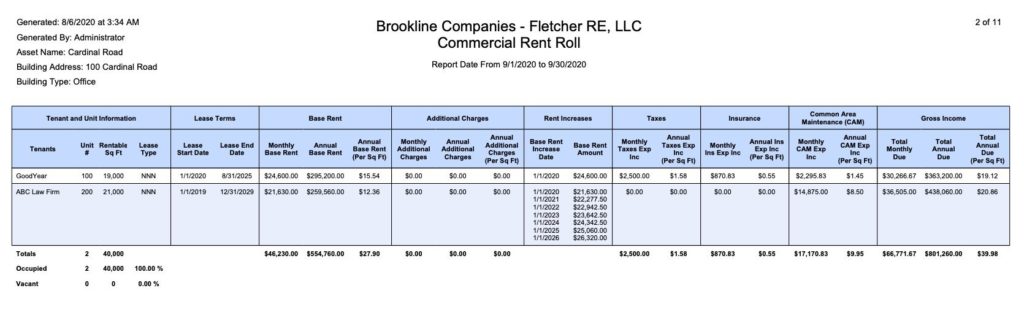
A proper report should show tenant information, unit information, property information, and a summary of rental income. Here’s what it should include:
- Tenant name and unit number
- Rentable square feet
- Lease type (NNN, gross)
- Lease start date and end date
- Monthly and annual base rent
- Any additional charges, insurance, CAM
- Rent increase dates/amounts
- Monthly and annual gross income
In addition to the information for each unit, a commercial rent roll document should display the property address, building type, and the date it was generated. Depending on your specific needs or other factors such as property type, you may include additional details as well that will vary depending on the exact circumstances. However, these basic items should always be included for the sake of completeness and easy reference. Often, this can save you having to hunt through multiple complex leases to find important information such as a tenant’s CAM charges.
Why Rent Roll Is Important in Commercial Real Estate
Rent roll provides several items of crucial information in a format that you can read at a glance. This makes them extremely useful in multiple scenarios to help you, your team, and others quickly see the big picture. Here are just a few of the ways commercial real estate professionals use them:
Property Management and Financial Insights
A rent roll is an easy reference point for property managers to see information such as how much each tenant owes, lease information like expiration dates and special circumstances, contact information, and more. Additionally, for your accounting team, The information contained in the document can help you calculate financial performance in terms of net operating income (NOI), and cap rate. It also makes it easy to compare the current rent being collected with market rent. This can help you decide how to adjust rates for the future.
Sharing Data with Investors, Lenders, and Buyers
All three of these groups will want to see your rent roll before entering into a business relationship. Providing clear, up-to-date documentation instills confidence in your real estate business, establishing a relationship of trust with investors, lenders, and buyers.
Investors will want to review the rent roll to understand current and future cash flow. That way, they can determine how the property is performing. Similarly, lenders will ask to see the rent roll before deciding whether to give out a loan. Finally, buyers will also want to see financials before they make a purchasing decision. Plus, if you’re considering selling a property, reviewing your rent roll can help you understand that property’s value and make more strategic choices about how to sell it.
Frequently Asked Questions
-
How can I share a rent roll report with investors and lenders?
STRATAFOLIO makes it easy to export rent rolls and other reports, which you can then quickly share with investors and lenders. Plus, a dedicated investor portal allows them to directly find key data.
-
How do I check if a rent roll matches my accounting records?
STRATAFOLIO’s rent roll generation features help eliminate most errors when creating the report, but it’s always smart to verify your data. With STRATAFOLIO’s two-way data sync with QuickBooks Desktop and Online, you always have access to your information so you can check your final rent roll report against your income, tenant and building data, and more.
Determine the True Value of Your Properties with STRATAFOLIO
As a commercial real estate owner or property manager, you need a way to generate rent roll. STRATAFOLIO’s rent roll software makes it easy always to have accurate, easy-to-read documentation on hand.
When a lender, investor, or buyer asks for rent roll, you’ll always have an up-to-date document available to share with them in just seconds. Plus, thanks to STRATAFOLIO’s complete bi-directional QuickBooks integration linking the software seamlessly to QuickBooks Online, QuickBooks Desktop, and Intuit Enterprise Suite, your financials will always be current, accurate, and automatically transferred between your property management and accounting systems. With STRATAFOLIO, you, your team, and your investors are always in the know.
Schedule a demo today to learn more about STRATAFOLIO’s rent roll capabilities, our many other tools as a cloud-based commercial property management software, and how we can help your commercial real estate business grow!