

The first Building Performance Standards (BPS) were passed over a decade ago. However, recently, the number of standards has increased greatly. The states of Washington, Oregon, Colorado, Maryland, and 24 cities across the country have all implemented one standard or another. It begs the question:
What is a Building Performance Standard?
Utilizing this new policy approach, Building Performance Standards focus on building energy efficiency and decarbonization. To date, 28 jurisdictions have passed a building performance standard or equivalent policy. The reduction targets set by the standard for each cycle are increasingly hard to meet, requiring continuous improvement and ongoing compliance every 5 years over the next two decades or more.
Your building may also have to comply with city, county, and state requirements. These requirements may be in opposition to each other, or they may be complementary. For example, a state standard may offer a carbon reduction as a compliance mechanism while the city only offers an energy reduction. Optimizing for energy reduction does not necessarily optimize for carbon emissions reduction. Electrifying HVAC equipment may reduce your total kbtu usage per square foot. However, it may cause an increase in your carbon emissions, due to carbon-intensive grid electricity. These standards apply to a large swath of commercial and industrial buildings and may include buildings as small as 10,000 square feet.
While the specific aspects of each BPS vary across jurisdictions, many include some or all of the following mechanisms of compliance to be completed on a reccurring cycle. Some are annual, while others may fall on a three, five, six, or ten year pattern.
Examples of Compliance Requirements
- Benchmarking Utility Data
- Building Energy Audit
- Building Water Audit
- Energy Management Plan
- Implementation of an Operations and Maintenance Program
- Retro-commissioning (RCx)
- 100% Renewable Electricity Standard
- Strategic Decarbonization Assessment
- Energy, Water, and/or Greenhouse Gas Emissions Reduction
- City and/or State Submittals
- Third Party Data Verification
There are great benefits to starting the compliance cycle early. While each standard has its own compliance date, many of these requirements take a year or longer to implement. Additionally, the investments required can be spread over more years, which lightens the compliance cost burden.
Why Should You Comply?
Penalties for noncompliance can greatly impact a building’s budget. For example, fines can reach as high as $1.50 per square foot + $5,000 in Washington, or $230 per metric ton of CO2 beyond your building’s allotment in Maryland. These penalties can result in $100,000s each year or each cycle, depending on the jurisdiction.
More importantly, compliance with these standards, if planned thoroughly and started early, can become a competitive advantage and increase value for building owners. Through decreased operating expenses, your NOI will increase, resulting in potentially higher building valuations. Early compliance could also result in expanded multiples due to decreased maintenance, standardized operations, and avoided penalties.
How to Comply
Each jurisdiction will have their own requirements for every unique building type. A detailed compliance plan and execution of that plan will be required to ensure compliance.
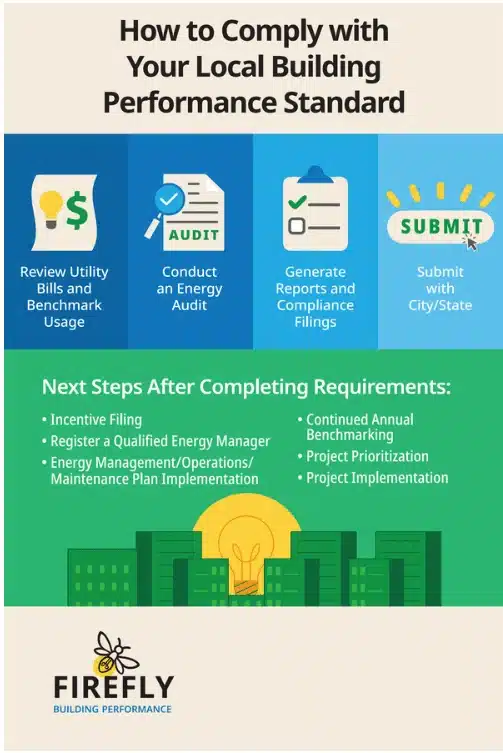
With that said, there are generally 5 steps to compliance:
- Review utility bills and benchmark usage
- Conduct building audits for water, energy, and carbon opportunities
- Generate the required reports, studies, and other compliance filings
- Submit the required supporting documentation to city, county, and/or state agencies
- After the initial compliance requirements, the following may also need to be completed:
- Registering a Qualified Energy Manager, as well as on site staff with your jurisdiction.
- The implementation of the various programs, plans, and projects needed to be completed for continued compliance.
- Recurring annual utility benchmarking
While these requirements are somewhat heavy lifts, the rubber meets the road with the equipment and building system investments that will be required to meet the standards.
The BPSs generally require deep cuts to energy and/or greenhouse gas emissions, some of which go so far as to require net zero emissions from buildings. This can mean hundreds of thousands to millions of dollars in system upgrades per building.
These investments will necessarily be large and if implemented without a plan can easily become onerous or potentially unmanageable, forcing the sale of the property. However, with an annual implementation plan that combines project management and the integration of incentives, alternative finance, and tax planning, this regulatory burden can be turned into a competitive advantage.
Compliance with Building Performance Standards is Important but Doesn’t Have to be Hard
It does, however, need to be customized to each individual building and its owner’s unique tax situation. BPS creates an opportunity for those willing to take the extra steps to fully take advantage of the shifts in local markets and build valuations.
If you need help navigating this complex, changing regulatory environment while maximizing the value of your buildings, take the first step with Firefly Building Performance.
Firefly Building Performance is your partner in the long journey ahead. They are ready to meet you and your building, where you are, and make compliance as frictionless as possible.