To many landlords and property managers, a common area maintenance (CAM) true-up is among those annual rituals one simply cannot get away from. Yes, it’s an important one, but let’s get real, not that much fun compared to signing a new tenant or increasing your net operating income (NOI). It means gathering all your estimates, comparing them to actual costs, double-checking pro rata shares, and making sure everything ends up in the right place. And when you’re juggling multiple leases, multiple buildings, and multiple accounting files? Things can get overwhelming fast.
Before we go deeper, let’s ground the terminology: a CAM true-up is simply the annual comparison between estimated CAM charges and the actual amount spent on CAM. This is the same process many people refer to as CAM reconciliation, and the two terms can be used interchangeably.
Below is a step-by-step CAM true-up guide for both landlords and tenants.
Step 1: Review Estimated CAM Charges at the Start of the Year
A proper CAM true-up starts well in advance of the end of the year. Tenants receive monthly bills for operating expenses which include CAM, insurance and taxes outlined in every lease. These projections also need to take into account anticipated running costs for expenses like shared utilities, landscaping, snow removal, and common area upkeep.
At this stage, the goal is not perfection, it’s accuracy within reason. But inaccuracies here trickle into the common area maintenance reconciliation, so this setup really matters.
Step 2: Track Actual Operating Expenses Throughout the Year
Throughout the year, landlords and property managers pay real invoices, utilities, maintenance vendors, insurance, repairs, and other costs that fall under operating expense reconciliation. For a clean annual CAM reconciliation, each of these costs must be logged correctly in the accounting system.
This is where mistakes usually happen:
- Weather spikes affecting snow or landscaping may result in misentered or unlogged costs
- New service contracts with different expenses may be incorrectly recorded
- Incorrect account mapping
- Vendor costs accidentally hitting the wrong category
All of this affects the accuracy of the final CAM true-up when the reconciliation is run.
Step 3: Confirm Pro-Rata Share Calculations
The percentage that determines how much of the total CAM cost a tenant must pay is known as the pro rata share. While leased square footage or even custom percentages are used, many leases compute this using rentable square footage.
Early verification of this number is essential because it directly affects the CAM true-up statement.
The cleaner the math, the better, as tenants tend to push back here.
Step 4: Compare Actuals vs. Estimates
Now we reach the heart of the CAM reconciliation process. The property manager needs to compare what the tenant was billed during the year (the estimates) against what the landlord actually spent in each category. This difference is what produces either:
- A balance due from the tenant, or
- A credit owed to the tenant.
Because the comparison includes multiple categories (repairs, utilities, taxes, maintenance), this is often the most time-consuming part of the operating expense reconciliation.
Step 5: Prepare the CAM True-Up Report
The final CAM true-up report must show:
- Total actual costs by category
- Tenant’s pro-rata percentage
- Estimated charges billed
- Balance due or credit
- Any adjustments or omissions
- Notes on controllable vs. non-controllable expenses
This report helps to keep things very candid and clear, which helps avoid any unnecessary confusion or disputes. When tenants can see exactly where the numbers fall, everyone can trust the process.
Step 6: Communicate With Tenants Clearly and Professionally
After reaching an understanding on numbers, the property managers are then responsible for remitting the annual CAM reconciliation/true-up package.
Tenants appreciate:
- Clean and detailed breakdowns
- Notes on any unusual cost increases
- Transparent math
- A description of the calculation of the end amount
Confusion can result in friction here, so it quite literally pays to be clear.
Where STRATAFOLIO Makes CAM True-Ups Easier
Now that we’ve covered the general process, here’s the good news: STRATAFOLIO removes most of the manual work that makes the CAM true-up feel painful.
Instead of switching between spreadsheets, QuickBooks, and manual calculations, STRATAFOLIO automates the most time-consuming parts of the CAM reconciliation workflow:
One-click CAM Reconciliation Reports
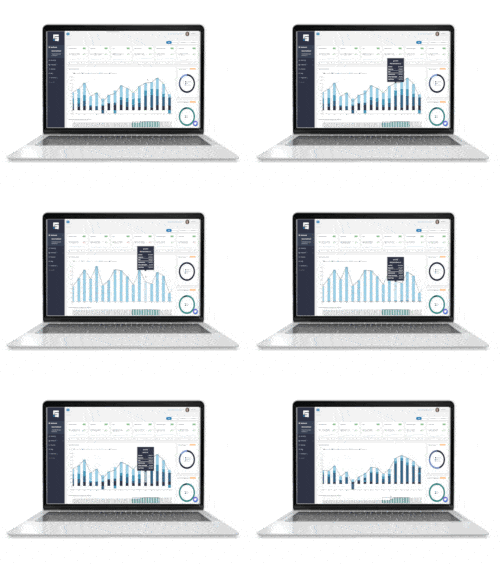
No more assembling information from general ledger accounts and invoices. Actuals, estimates, pro-rata shares, and discrepancies are automatically compiled by STRATAFOLIO into a clear and downloadable file or report.
Automatic Mapping Between COA and CAM Categories
Instead of manually mapping accounts, STRATAFOLIO links QuickBooks accounts to CAM categories for consistent common area maintenance reconciliation.
Accurate Cash-Basis Actuals
STRATAFOLIO’s integration with QuickBooks provides straightforward access to paid expenses, eliminating manual entry errors.
Built-in Pro-Rata Share Precision
Using up to 15 decimal places, STRATAFOLIO ensures you never lose accuracy due to rounding, especially important for multi-tenant buildings.
Easy Review Before Finalizing
Direct confirmation shows:
- CAM categories
- Subcategories
- Periods
- Rate changes
- Caps overrides
This review should also flag anything unusual, making it easier to spot and handle errors before creating your final CAM true-up report.
Try STRATAFOLIO for a Stress-Free CAM True-Up Experience
A CAM true-up does not have to be chaotic. Having the right process and tools makes it easy to provide an accurate report without losing transparency with your tenants or facing end-of-year surprises. STRATAFOLIO maintains a structured process for a CAM true-up but removes the most frustrating elements.
Schedule a demo today and see how easy the entire CAM reconciliation process can be.