Adding a Unit to STRATAFOLIO is straightforward once you know where to start. Units fall under Buildings in the STRATAFOLIO Hierarchy (left). Since Unit(s) are always part of a Building, to add a Unit you will start at the Building Details page.
For more tips & information on Units, check out our Understanding Units in STRATAFOLIO knowledge base that covers units in more detail.
Understanding Units
Units in STRATAFOLIO are used to define rentable spaces within a building. In some buildings, they may be called suites, rooms, or even an entire floor, which can be defined as rentable space within a building. Most buildings have more than one unit, but some buildings (single-family homes, for example) will only have one rentable space.
In STRATAFOLIO, Unit(s) is a required field for a Lease. Even for buildings with only a single space to lease, you will need to enter a unit number in STRATAFOLIO.
Unit Numbers
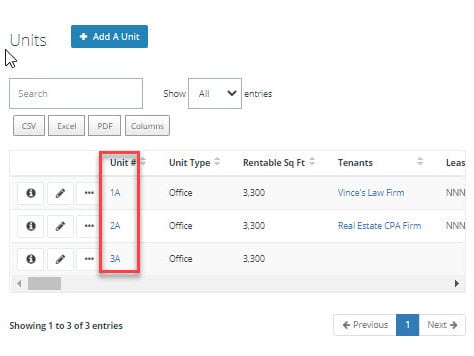
Units are most often entered as a number (1, 104, 18, etc.). But you can also use words for your unit, such as “Ground” for a ground floor unit. Or “2nd Floor” if the lease is for the entire 2nd floor. Also, when there is a single unit building, you can use the unit’s address, “203” for 203 Main St., or you can use “1” for the unit.
More Than One Unit Per Lease
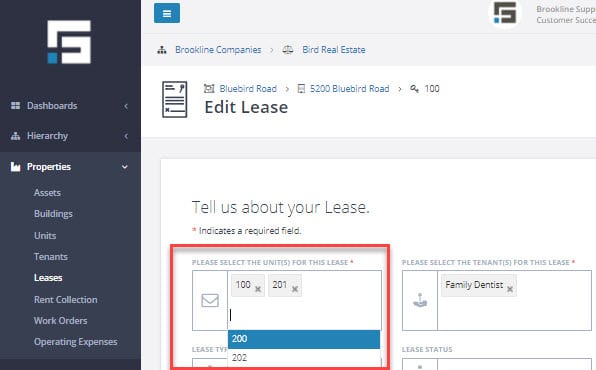
You can add more than one unit to a lease. If a tenant has one lease for two (or more) units in the same building, you can add both units under one lease. However, if the tenant has separate leases, pays separate rates for each unit, or the units are in different buildings, it is usually better to enter the units separately and not combine them under one lease.
Unit Type
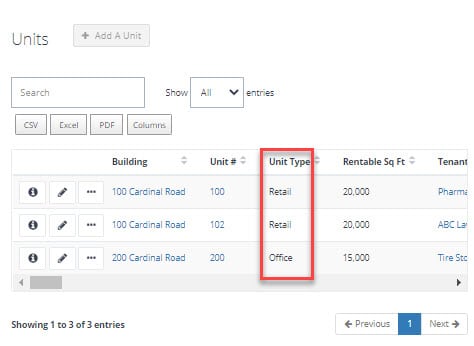
The unit type helps to describe your unit. When adding a new unit to a building, the Unit Type options will be limited based on the Building Type you selected.
TIP: To change the Building Type, you will need to edit the Building information.
Is there a new Building Type that you would like to see in STRATAFOLIO? Let us know! Email us at [email protected].
Rentable Square Footage
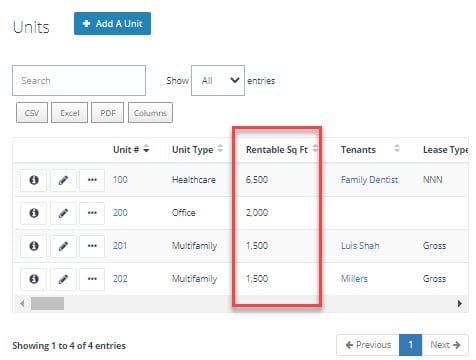
The square footage of a unit should be as accurate as possible. If you don’t have the square footage of the unit handy, you might be tempted to enter a guess – however, rentable square footage is an important input!
TIP: The square footage for the unit is used in several calculations in STRATAFOLIO. Some examples are:
 Calculating the percent occupancy of the building. Calculating the $/square foot for each unit. Calculating the tenant’s share of the Common Area Maintenance,
Real Estate Taxes and Insurance expenses.
Edit Unit Details
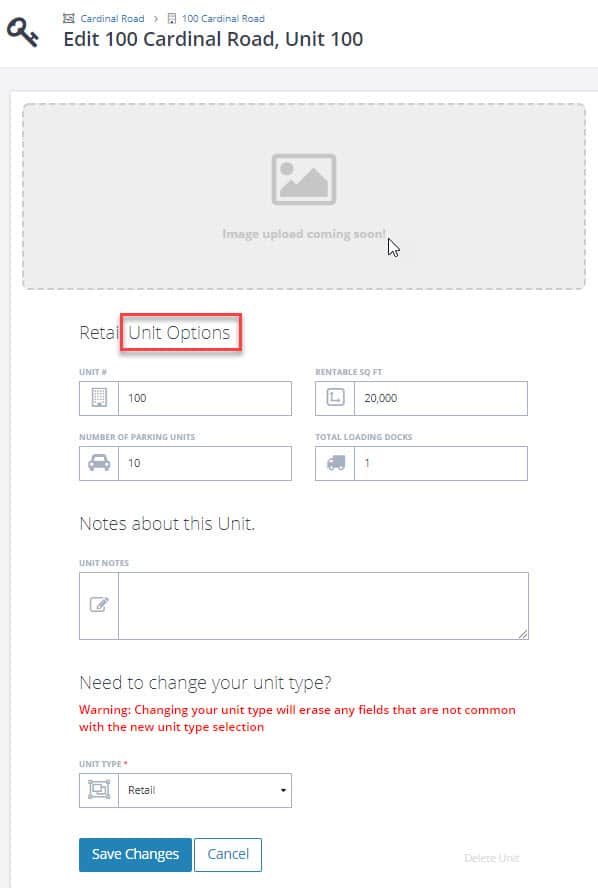
Entered a unit number wrong? Need to update the square footage? Remodeled and changed the Unit Type? No problem. You will want to navigate to the Unit Options page where you can update all of the Unit information.
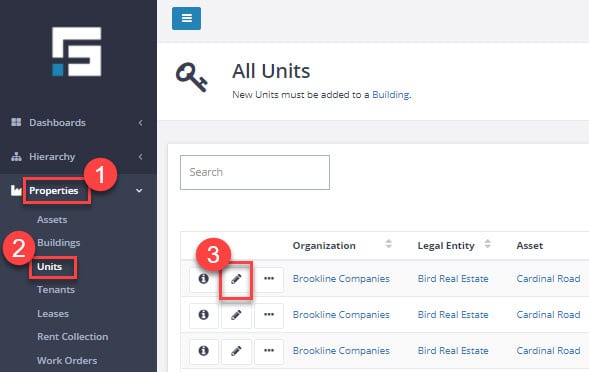
Starting in the left-side navigation panel:
- Select Properties.
- Select Units.
- Select the pencil next to the unit that you want to edit.
You should now be on the Unit Options page where you can edit/update any of the unit details.
Deleting a Unit
Deleting a unit is pretty simple, however, STRATAFOLIO only allows you to delete a unit if there aren’t any leases attached to it. ALSO NOTE: If there is an expired lease attached to the unit – you will not be able to delete the unit in STRATAFOLIO.
To delete a unit, follow the steps above in the EDIT UNIT DETAILS section to open the Unit Options page.
Once on the Unit Options page, scroll to the bottom and look for Delete Unit in the lower right.
- If Delete Unit is red, select it to delete the unit.

- If Delete Unit is grey, the unit is attached to a lease and you will not be allowed to delete it in STRATAFOLIO until the connected lease is removed.

How to Add a Unit
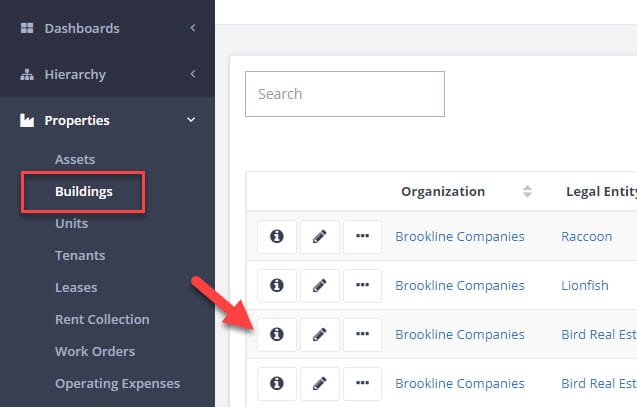
Navigate to the Building Details page
Start on the left-side navigation panel under Properties, navigate to Buildings then select the
TIP: If you have a lot of buildings in your portfolio, use the SEARCH box to find the building you are looking for.
Navigate to the Units tab.
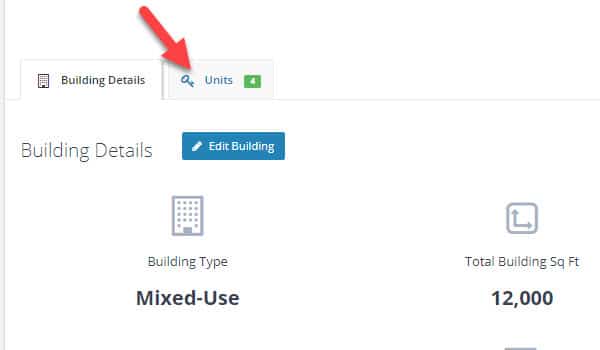
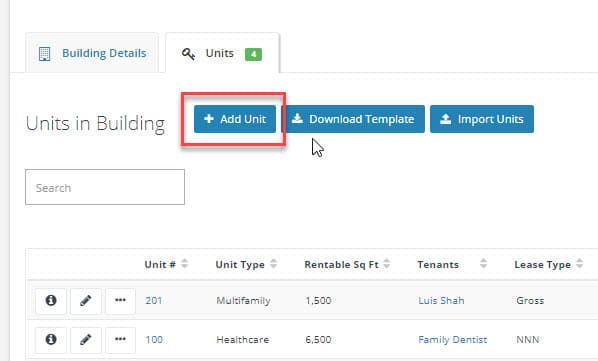
Select Add Unit
Select Your Unit Type
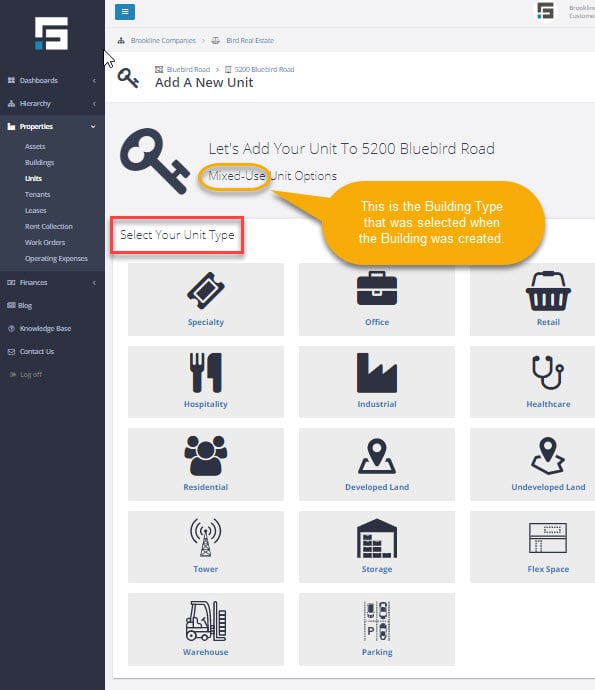
Once on the Add A New Unit page, you will see several options for the type of unit that you are adding. Select the one that best matches your unit.
NOTE: If you do not see an appropriate option for your unit on this page, you may have entered a Building Type that limits your options. For example, if the Building Type is Office, you will not be able to add a Hospitality unit to the building. Similarly, you will not be able to add a Residential unit to a Building Type designated as Industrial. To change the Building Type, you will need to edit the Building information then you can navigate back to the Add A Unit page to select the desired unit type.
Add Unit Information
Once you have selected the unit type, the Add a New Unit page will open, and you can add the unit details. The type of unit you chose (Office was used for this example) will appear in several places on this page, but the information fields on this page will be similar for each unit type.
NOTE: Residential Units also include options to list the Number of Bedrooms, Number of Bathrooms (full & half), and Pet Options.
Each information field for an Office Unit is discussed below.
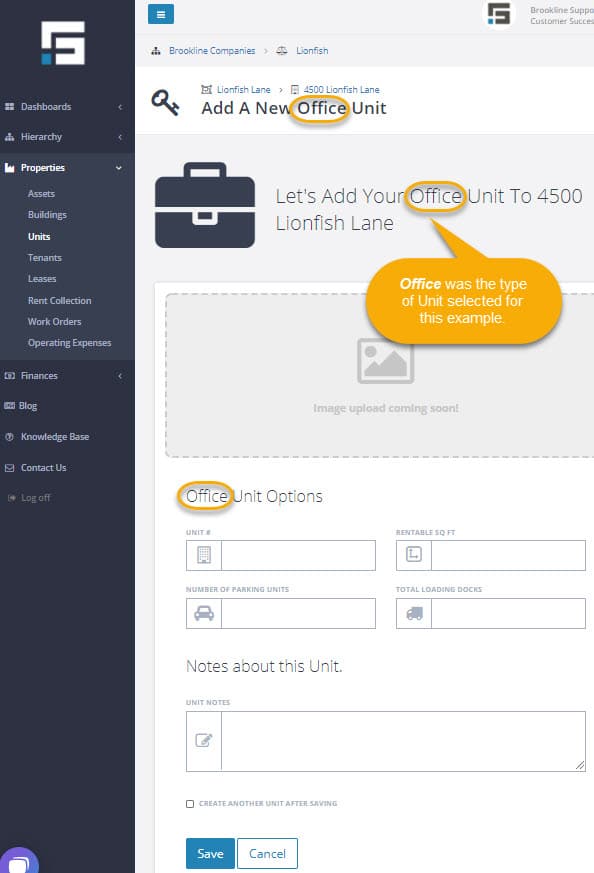
Unit # – In this field enter what you would like to call this unit. Unit # can be a number or a word. Examples: 1st Floor, 100, Storage, Warehouse, 3829, etc.
NOTE: If you leave the UNIT # field empty, it will display as N/A in the unit list for the building.
Rentable Sq Ft – This should be the most accurate square footage you have for this unit. STRATAFOLIO will use the square footage to calculate several things: 1) the percent occupancy of a building, 2) the rent cost per square foot, 3) the Common Area Maintenance costs that apply to this unit, and other information. It is important to enter an accurate number in this field.
Number Of Parking Units – If parking spaces are assigned to this unit, you can enter that number here.
Total Loading Docks – If the unit has loading docks, enter the number here.
Unit Notes – This field is for any additional information you want to enter about this unit. For example, if the unit has something special about it – like it has a large street-facing window, or the unit has its own restroom. In addition, you can add a note about renovations or changes to the unit.
Choose Save, and you are done!
Once you have added all the information for the Unit, select SAVE at the bottom of the page.
NOTE: It may take a few seconds for your new unit to appear in STRATAFOLIO. If you do not see it right away, wait a moment and refresh the page.
Once you choose save, you will be on the Unit Details page where you can review the information for the Unit you just entered. If you need to make a change, select Edit Unit.
Splitting a Unit When a Tenant Gives Back Part of Their Space
Sometimes a tenant does not renew their full space. They may keep part of a suite and give back the rest, or a tenant occupying an entire floor may downsize to a single unit. When this happens, you will need to split the original unit into two or more units in STRATAFOLIO and update the lease so your Rent Roll, invoicing, and CAM reconciliations stay accurate.
The Golden Rule: Keep the Total Square Footage the Same
Before you change anything, know this: the total Rentable Sq Ft of the new units must equal the total Rentable Sq Ft of the original unit. If the numbers do not match, the pro rata share used for CAM reconciliations, Real Estate Taxes, and Insurance will be wrong. This affects not just the tenant whose space is changing. It affects every tenant in the building because the pro rata share is calculated using the building’s total Rentable Sq Ft as the denominator.
EXAMPLE: A tenant currently occupies Suite 100, which totals 6,845 Rentable Sq Ft. They are giving back part of the space and keeping only 3,207 Rentable Sq Ft. The remaining 3,638 Rentable Sq Ft needs its own unit. Added together, 3,207 plus 3,638 equals 6,845, the same total as the original unit. If your new measurements do not add up this cleanly, see the Best Practices section below for how to check your numbers before making any changes.
Step by Step: How to Split a Unit
Step 1: Add a New Unit for the Space Being Given Back
Follow the steps in the Edit Unit Details section above to navigate to Properties, then Units, or go to the Building Details page and select the Units tab. Select Add Unit and create a new unit for the space the tenant is relinquishing. Enter its Rentable Sq Ft as accurately as possible.
Step 2: Update the Square Footage on the Original Unit
Go back to the original unit and select the pencil icon to edit it. Update the Rentable Sq Ft field to reflect only the space the tenant will continue to occupy going forward.
Step 3: Add the New Unit to the Current Lease
A single lease can include more than one unit as long as the units are in the same building. Before the space changeover happens, add the new unit to the tenant’s current lease alongside the original unit. This lets STRATAFOLIO run CAM reconciliations correctly for the full space the tenant occupied during that period.
Step 4: When the Tenant Gives Back the Space, Expire the Current Lease
On the date the tenant relinquishes the space, expire the current lease. Then create a new lease for only the unit the tenant is keeping. You can copy most of the details from the original lease into the new one and change only what is different, such as the rent amount or lease term. Many teams label this a lease amendment in their own naming convention. Note in the lease record why the change was made, so anyone reviewing the tenant’s history later understands the space reduction.
Step 5: Understand How Your Rent Roll Will Reflect the Change
During the period the tenant occupies the full combined space, your Rent Roll will show them in every unit on that lease. Once the lease expires and the new lease begins, the tenant will show up only in the unit they kept. The unit they gave back will appear as vacant on the Rent Roll until you add a new lease for it.
More Information: Checking Your Numbers Before You Split a Unit
If you are remeasuring an entire building and expect several units to change at once, do not make the changes directly in STRATAFOLIO first. Instead:
- Export your building’s Units table. Every table in STRATAFOLIO has an Export button in the upper right corner that lets you download the data to Excel or CSV.
- Add columns for your new measurements next to the existing Rentable Sq Ft numbers.
- Compare the totals. Add up the new measurements and compare them to the building’s current total Rentable Sq Ft.
This tells you, before you touch anything in STRATAFOLIO, whether you can make the updates with no further adjustments, whether you need to add a unit to cover a gap in the floor, or whether you need to use the Building Square Footage as Stated in the Lease override.
If Your Numbers Do Not Add Up
If the new measurements do not total the original unit’s Rentable Sq Ft, you have two options:
- Add another unit. If the new unit does not cover the entire rest of the original space, add an additional unit for the remaining difference. In this case, you would place all of the resulting units on the original lease while the tenant still occupies the full space.
- Use the Building Square Footage as Stated in the Lease override. If the lease itself states a different Rentable Sq Ft or pro rata share than what STRATAFOLIO calculates from your building’s units, you can override the number used for that lease’s CAM reconciliation. You will find this override at the bottom of the Edit Lease screen. It changes the calculation for that one lease only. It will not display in the STRATAFOLIO unit table, but it will be reflected in the exportable CAM reconciliation report.
Choosing a Unit Name That Will Last
The name you give a Unit stays with that Unit long after a tenant moves out. Unit names are permanent identifiers for the rentable space itself, not the tenant who currently occupies it. When a Lease ends and a new tenant moves in, the Unit name does not change. That is why it is important to think carefully about how you name your Units from the very beginning.
A common mistake is naming a Unit after the current tenant. For example, naming a Unit “Joe’s Coffee Shop” or “Smith Dental” feels natural while that tenant is in place. The problem starts when that tenant leaves. The Unit will still appear in your Rent Roll, reports, and Lease records as “Joe’s Coffee Shop,” even when a completely different business now occupies the space. Over time, this makes your portfolio harder to read, report on, and understand for new team members.